 Request an Interpreter
Supporting Strength, Independence, and Full Participation in School Life
Physical Therapy
At Mill Neck Manor School for the Deaf, our Physical Therapy (PT) program is designed to help students thrive — academically, socially, and physically.
What Is School-Based PT?
Physical Therapy (PT)
Students typically receive individualized, 1:1 physical therapy sessions lasting 30 minutes, as determined by their IEP (Individualized Education Plan). Services are generally provided one to three times per week, with some students receiving monthly consultation support.
Each session is tailored to the student’s unique strengths, needs, and goals, based on evaluation findings and IEP objectives. Therapy is delivered using a total communication approach, incorporating American Sign Language (ASL), spoken English, gestures, Picture Exchange Communication System (PECS) boards, and Augmentative and Alternative Communication (AAC) devices to ensure full accessibility and understanding.
Visual schedules may be used to help students anticipate activities and understand expectations. To keep sessions engaging and motivating, therapists often incorporate SMART Board activities, interactive movement exercises, and music — creating a dynamic environment where students can build strength, coordination, and confidence.
Sessions
Min
Week
Areas of Support
Physical therapy focuses on strength, endurance, balance, coordination, motor planning, gross motor skills and overall mobility. It also addresses safety awareness and injury prevention.
Strength
Maintaining strength of the head/neck, core/trunk and extremities are essential for students to: sit upright with adequate postural alignment, attend in the classroom, perform school-related fine and gross motor skills, and keep up with their peers in the classroom, on the playground and in physical education class. Strength is also needed for students to perform tasks such as lifting and carrying their school supplies, walking and climbing stairs.
Endurance
Muscular endurance, or the ability of the muscles to perform repeated contractions over time, is essential for daily activities like walking, running, climbing stairs, and playing games and sports. Strong muscles provide support and stability to the joints and bones, decreasing the risk for injuries. Muscular endurance contributes to the development of gross motor skills, leading to increased energy levels and reduced fatigue. Cardiovascular endurance, or the ability of the heart and lungs to deliver oxygen to the muscles, is important for physical performance during exercise and gross motor skills. It also aids in improved cognitive functioning, memory, academic performance and overall mental health. Cardiovascular endurance can reduce stress and anxiety levels.
Balance
Good balance is needed for students to navigate their environment safely and efficiently, increase their body and spatial awareness, and engage in tasks without falling or bumping into obstacles. Balance encourages students to enhance their coordination and fine and gross motor skills, making their everyday tasks easier and more manageable. Engaging in balance activities helps students build muscle strength and endurance, contributing to overall physical fitness. Improved balance and coordination makes it easier for students to participate in group activities and sports, fostering social interaction and teamwork. Good balance also enables students to perform their daily tasks more independently, enhancing their autonomy and confidence.
Coordination
Maintaining good coordination is vital for students to take part in school-related movement activities such as games, dances, shows, sports, exercises and other movements. Increased coordination can contribute to better self-regulation and the ability to manage movements, which can improve classroom behavior. Improved coordination also fosters independence with manipulating objects such as toys, clothing puzzles and classroom supplies.
Motor Planning
Motor planning skills are also necessary for participation in games, shows, sports and recess. Students with good motor planning skills are able to better plan activities and participate in organized games and play, which can improve their social interactions. Motor planning is also important for self-care tasks such as getting dressed and performing personal hygiene.
Gross Motor Skills
walking, running and climbing stairs; building strength, balance and coordination skills; and
improving memory, executive function skills, and overall academic performance. Improving the
mobility of students allows them to participate and engage in learning activities, navigate the
school environment safely,interact with their peers, and develop social skills. Moving and
changing perspectives can aid in learning and retention of information. Students receive mobility
training with orthotics and adaptive equipment if warranted.
Safety Awareness
walking, running and climbing stairs; building strength, balance and coordination skills; and
improving memory, executive function skills, and overall academic performance. Improving the
mobility of students allows them to participate and engage in learning activities, navigate the
school environment safely,interact with their peers, and develop social skills. Moving and
changing perspectives can aid in learning and retention of information. Students receive mobility
training with orthotics and adaptive equipment if warranted.
Physical Therapy Activities
Physical therapy sessions are active, engaging, and individualized. Activities are designed to build strength, coordination, balance, endurance, and motor planning skills in fun and motivating ways.
Sessions often incorporate SMART Board activities, music, and movement-based games to keep students engaged while building critical physical skills.
-
Animal walks, obstacle courses, and scooter board activities
-
Core strengthening exercises such as bridges, planks, and yoga poses
-
Balance beam walking and stepping over hurdles
-
Jumping, hopping, skipping, and coordinated movement drills
-
Ball skills including throwing, catching, dribbling, and kicking
-
Interactive games such as Simon Says, Freeze Dance, and hopscotch
-
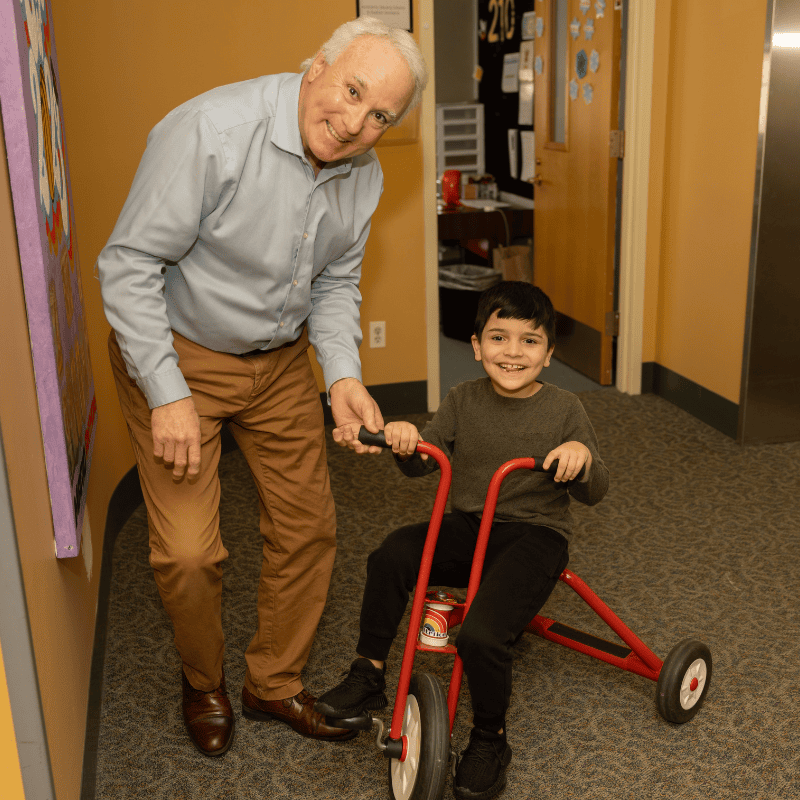
Bike riding and outdoor mobility practice
-
Stretching and body awareness exercises
Collaboration with Teachers & Families
There is collaboration between the teachers and therapists to integrate the curriculum into PT sessions. Therapists communicate with the classroom and physical education teachers to gather information regarding what impairments or functional limitations the students have, and how they can be addressed during PT sessions. The learning environment is made accessible through modifications, appropriate or adaptive seating, or suggestions from the therapists.
Progress made during therapy is then integrated within the classroom. There is also collaboration with families. Parents and caregivers receive training either virtual or in person concerning recommended home stretches, exercises or movement activities.

Admissions & Referral Process
Students may be referred for school-based occupational therapy (OT) and/or physical therapy (PT) by a teacher, parent or caregiver, health service professional, or IEP team member. A referral may be appropriate if a student’s physical, motor, or sensory challenges are impacting their ability to fully participate in school.
Before an evaluation can take place, written consent is required from both the parent/guardian and the student’s physician.
evaluation process
Evaluations focus on how the student functions within the school environment and how therapy may support greater independence and access to learning.
Therapists use clinical observation, input from teachers and families, and standardized assessments when needed.
Following the evaluation, a comprehensive report is shared with the IEP team. If services are recommended, individualized goals and therapy supports are developed and implemented as part of the student’s IEP.
Occupational Therapy
Occupational therapy assesses fine motor skills, sensory processing, visual-motor integration, upper body strength, and self-help skills.
Physical Therapy
Physical therapy assesses strength, balance, coordination, gross motor skills, mobility, and safe access to the school environment.
Standardized Testing
- Peabody Developmental Motor Scales: Second Edition (PDMS-2)
- Bruininks-Oseretsky Test of Motor Proficiency, Second Edition (BOT-2)
- School Function Assessment (SFA)
- Test of Visual Perception Skills, Fourth Edition (TVPS-4)
- Sensory Profile